Shakespeare and Cryptography 101: The Friedman Conditions
For as long as there has been a question around the authorship of Shakespeare, there have been those who have tried to find encrypted messages in the work. From Baconians to Marlovians to Oxfordians and others still, the field of Shakespearean cryptography has been filled with suitors, and most of these claims have ranged from a little bit mad to… well, quite a lot bit mad. So let’s take a clear look at the main types of ciphers and the terminology of Shakespearean cryptography.
Terminology and Definitions
In the strict terminology of cryptology, we may talk of a cipher, in which letters are placed or substituted according to a key, as being something different from a code, in which words or other symbols have specific meanings known only to the communicating parties.Cryptography around Shakespeare’s works deals primarily around ciphers.
There are two types of cipher; substitution ciphers, in which the letters of a cleartext, or the original message, are substituted with other letters according to a specific key. Substitution ciphers, by their very nature produce an encrypted text that is unreadable gibberish, as opposed to transposition ciphers.
There are two types of transposition cipher, keyed and unkeyed. Acrostics are the best example of a keyed transposition cipher, in which the letters of the cleartext message are transposed into a larger body of text, the open text in a specific pattern. That pattern, whether the first or last letters of successive sentences, successive paragraphs, or even more complex variations, is the cipher’s key.
There are also anagrams, in which the letters of a word or sentence are mixed around in placement to form another word or sentence. Because anagrams have no structure to show which solutions are intended, they are called unkeyed transposition ciphers.
Elizabethan Usage
Cryptography was a recognized part of Elizabethan intellectual and political life. Shakespeare’s contemporaries used a wide variety of cryptographic tools, from substitution ciphers and one-time pad systems for secure communications to acrostics and anagrams concealed in texts as puzzles or games. However the lack of standardized spelling or punctuation, and the loose practices of Elizabethan printers make for a number of specialized problems in attempting to find a decryption.
The Friedman Conditions
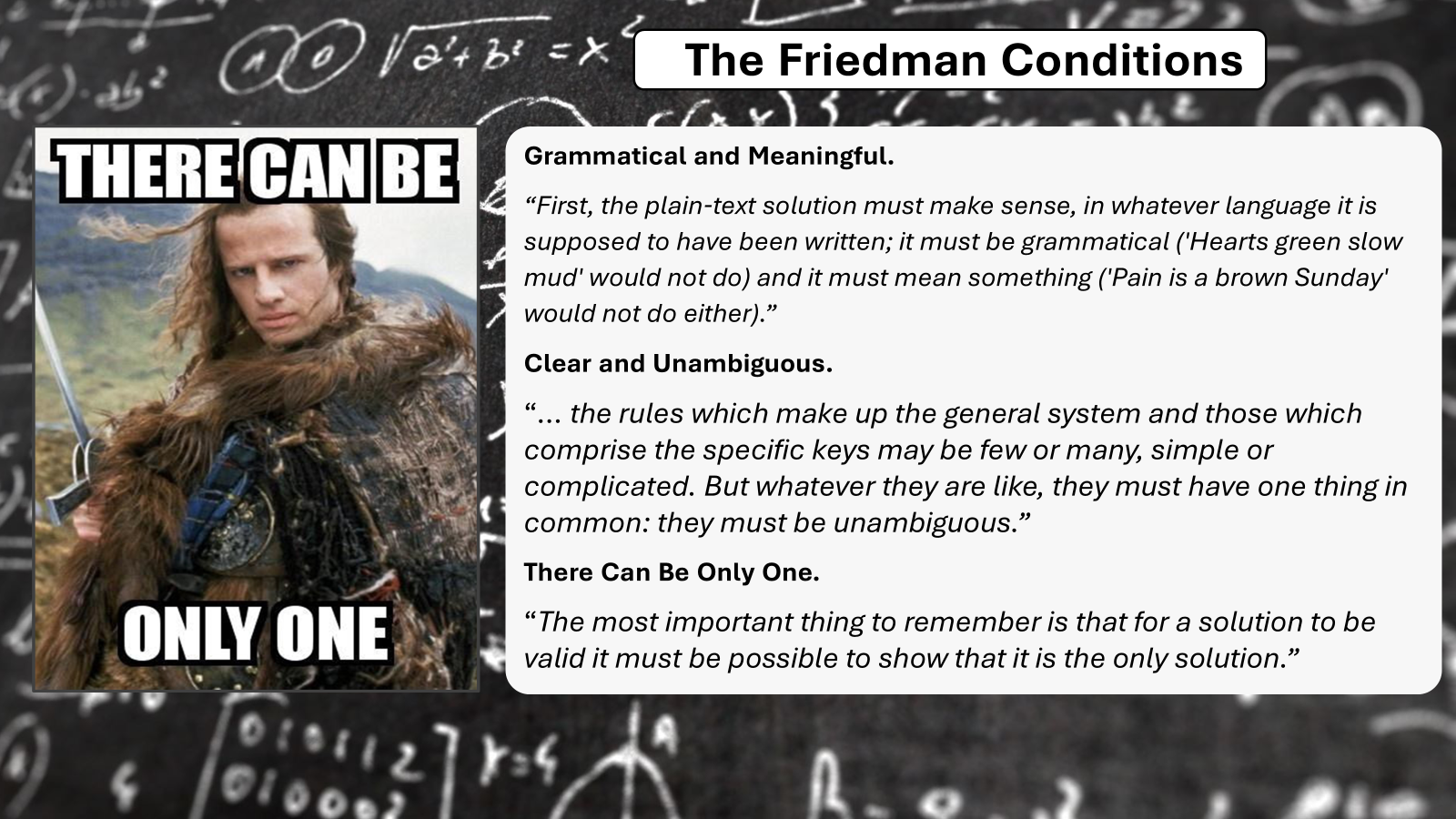
It is therefore reasonable to investigate whether Shakespearean texts might contain deliberately concealed information. But discovering a pattern is not the same as demonstrating that it was intentional. The challenge is to distinguish genuine cryptographic communication from coincidence, selective interpretation, and patterns produced by the investigator.
In their landmark work on the subject, The Shakespearean Ciphers Examined, two of the greatest cryptographers ever to marry each other, William and Elizebeth Friedman debunked all known cryptographic claims of authorship within the Shakespearean Corpus. They also established the properties to be required of any genuine claim, properties now known as the Friedman Conditions.
Genuine Messages
The Friedmans showed us two genuine authorship messages, both encrypted via keyedtransposition ciphers – acrostics.
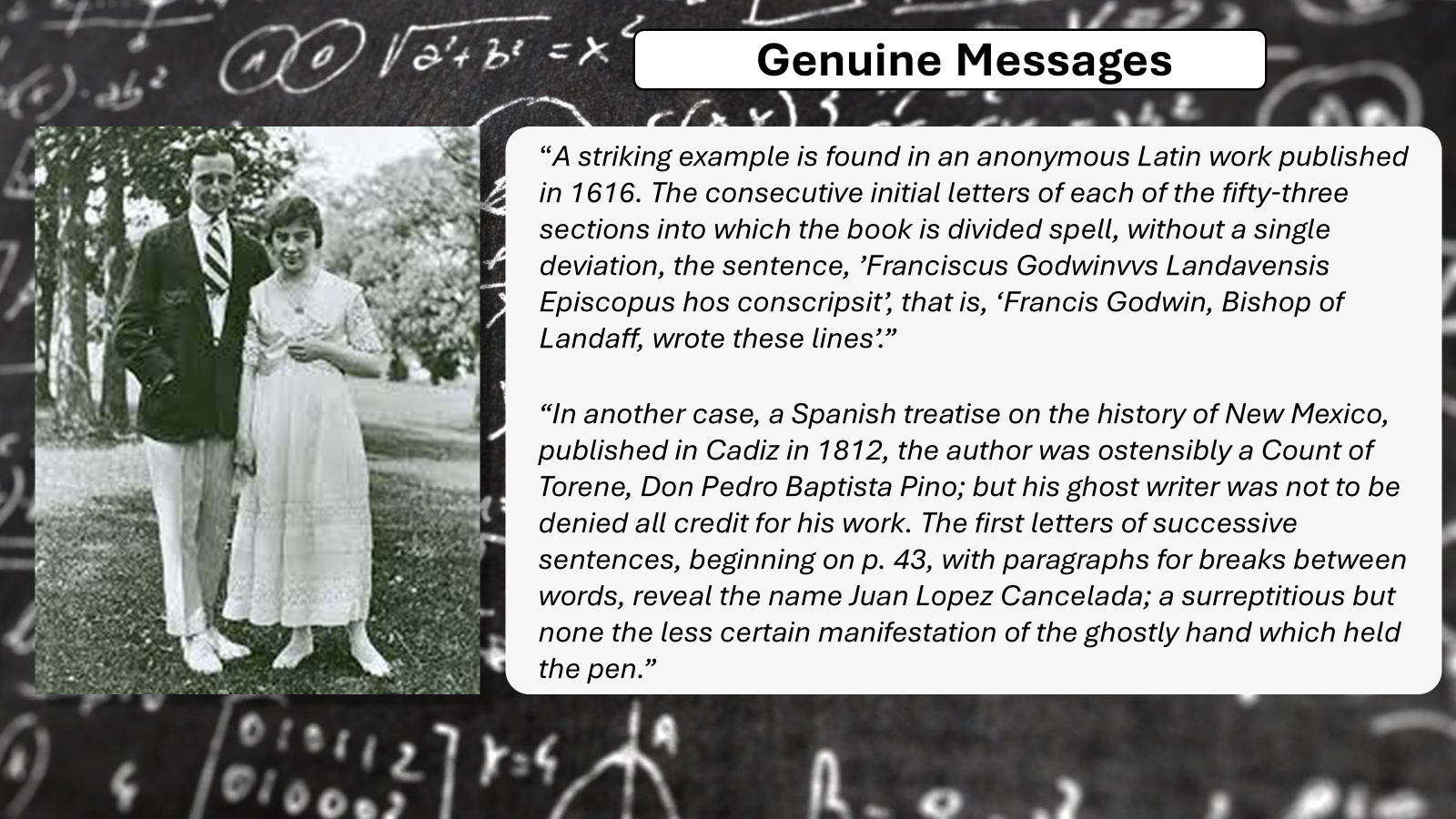
An equally striking, more contemporaneous, and more relevant example of an acrostic may be found in the device in this poem:
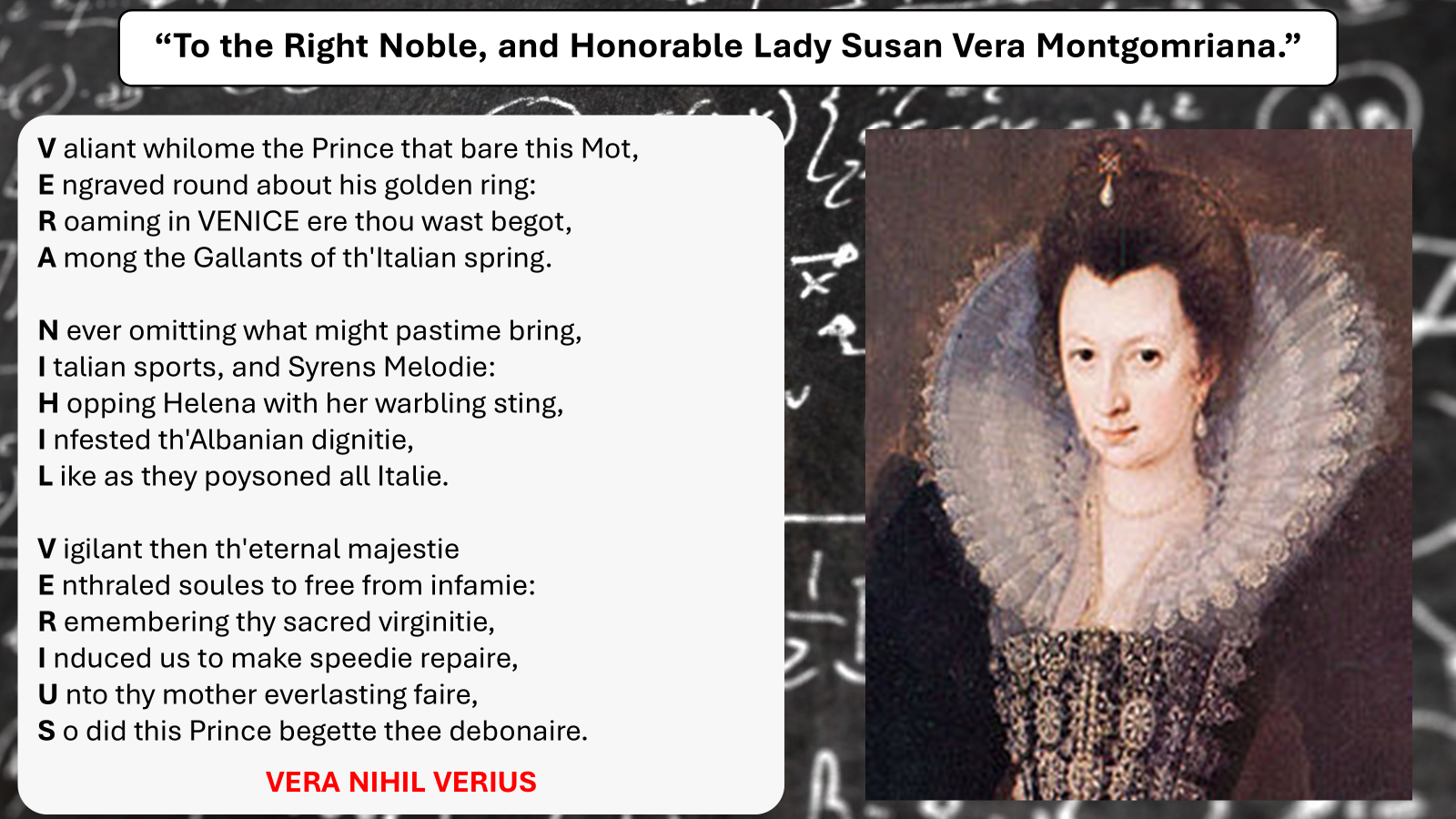
This poem was written by Nathanel Baxter, who traveled with the Earl of Oxford on his Italian journey, and is addressed to the Countess of Montgomery, Oxford’s youngest daughter, Susan Vere. Here, the initial letters of each line, with breaks for words spell out Vera Nihil Verius.
This is another example of an encrypted message that passes the Friedman Conditions. The message is clear, grammatical and meaningful, in fact it is a Latin pun that directly references the heritage and gender of the recipient. We can also see that the cleartext both references and is referenced by the outer text. The motto has been feminized for the recipient, and the outer text speaks of the inner motto that Susan's father did indeed wear engraved around his signet ring. These references, like the Bishop of Llandaff who “wrote these lines”, are strongly indicative of a meaningful message.
As well, each break between the words of the motto corresponds to a break in the outer content. Each word of the cleartext corresponds to a kind of paragraph in the poem. Each paragraph has a number of lines corresponding to the letters in the word. These authorial anomalies draw our attention to the existence of the acrostic.
By the Friedmans’ own example, an acrostic such as this has only one solution to the encoding algorithm – an acrostic – and the key – the first letter of successive sentences. But this does not, in cryptographic terms, mean that this is the only solution present.
In any substantial body of text, some random acrostic solutions are inevitable. We call these “spurious keys.”
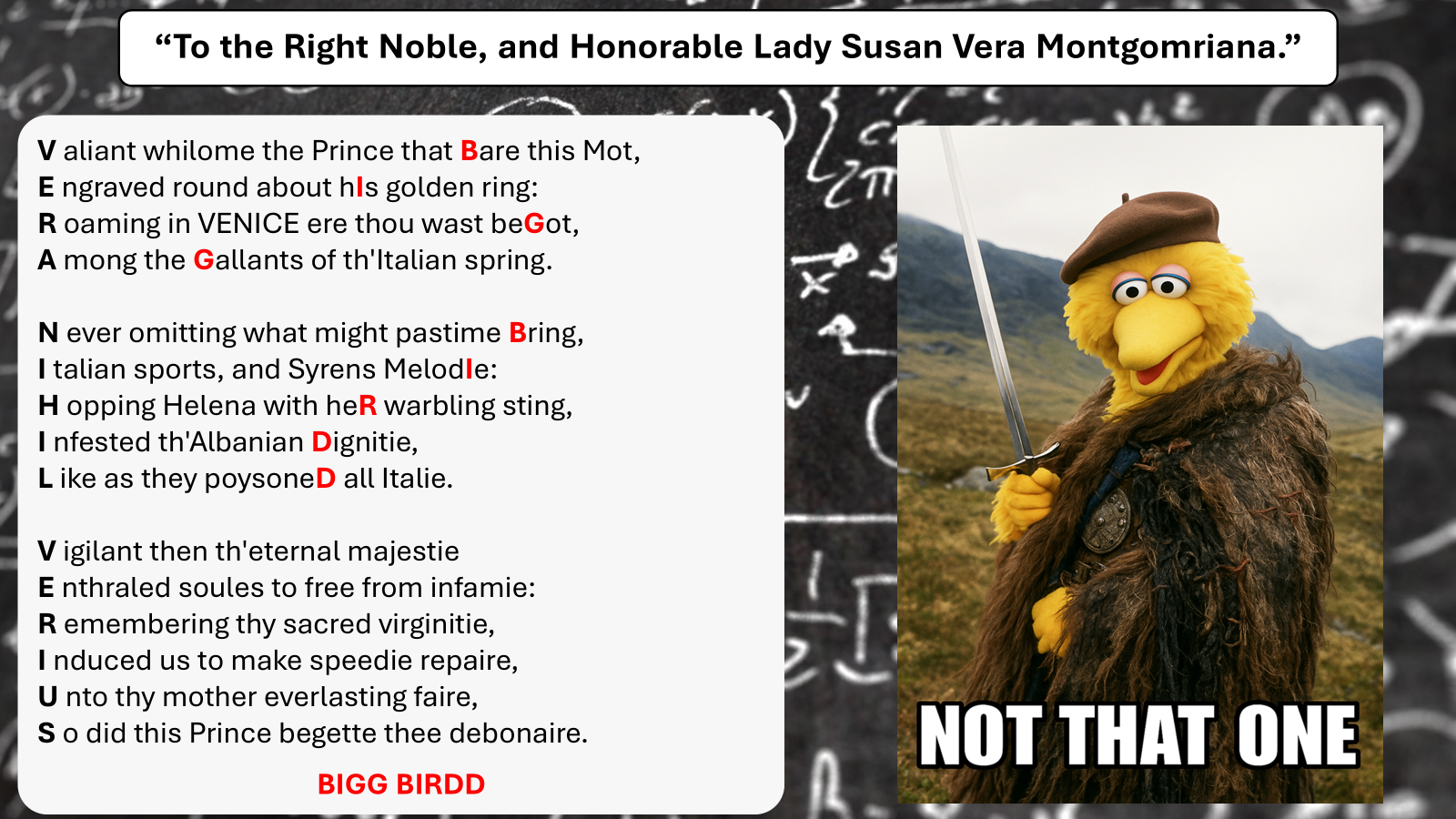
Just because I can tease out a solution that says “Bigg Birdd”, this does not imply the existence of an immortal Muppet. We can see that the message is barely grammatical, not very meaningful, and that the key is ambiguous, without any apparent pattern that can be derived. It looks like someone simply chose the letters they wanted in the positions they were already in rather than placing letters in a pattern and writing the content around that pattern. These are all indications of a spurious key.
On the other hand, a genuine message shows an easily derivable key, with a patterned structure. The Friedmans cited the structural anomalies of those genuine keys – fifty-six consecutive section headers, with paragraph breaks for words, for example - to show why these keys were clearly intentional.
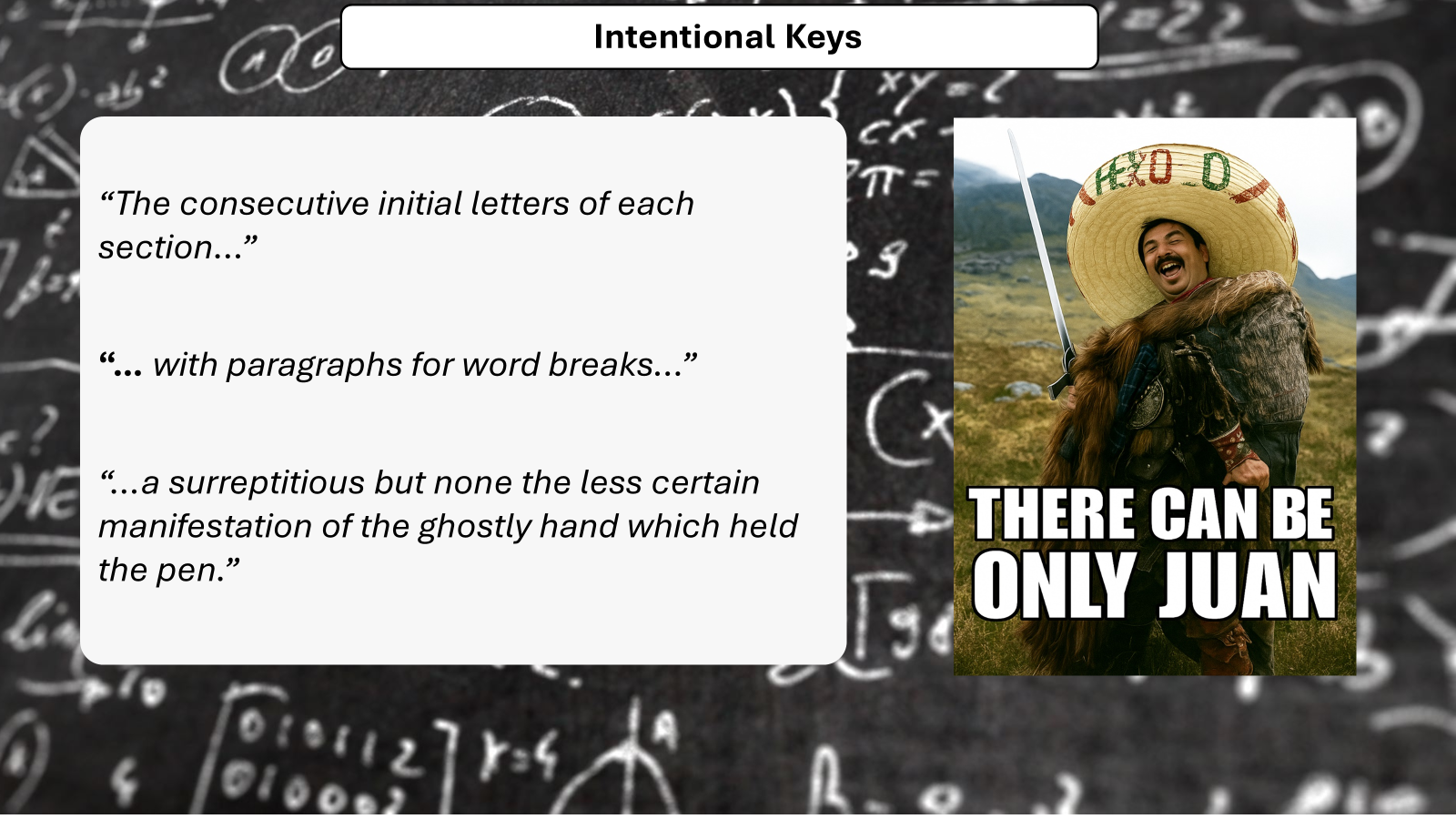
That the open text has been written to create, accommodate, and often reference the encryptedmessage also strongly establishes the integrity of the message, as the Friedmans also explained:
“Acrostic devices have the advantage that, unlike ciphers which depend on accidents of page-numbering or particular kinds of type, they leave no doubt that the author of the open text must also have been responsible for any hidden message – once it is established that one exists… If, therefore, any genuine messages of this kind exist, they must be taken as conclusive.”
The Problem with Anagrams
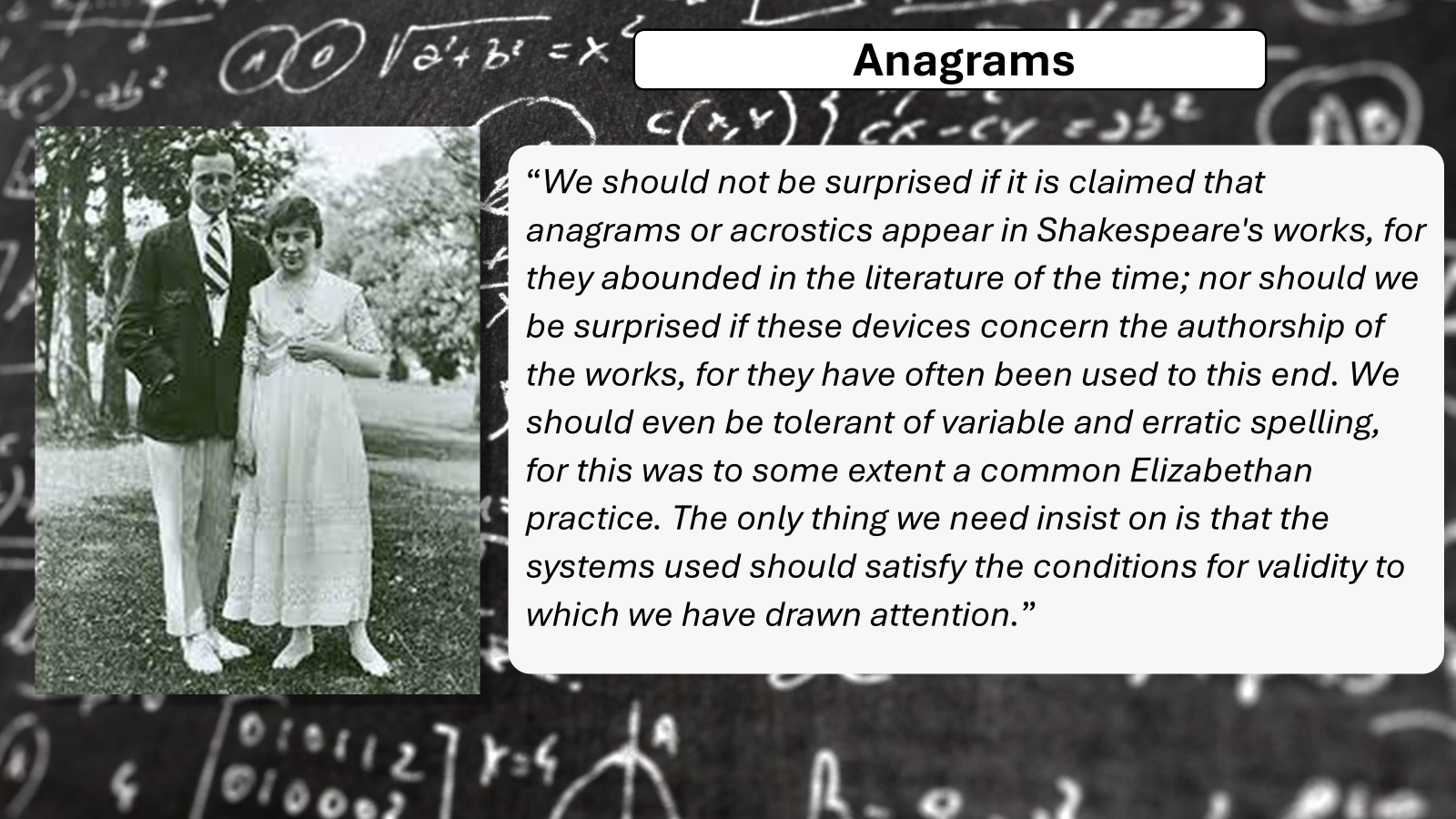
Anagrams, on the other hand, are something of a problem. Again I will let the Friedmans explain.
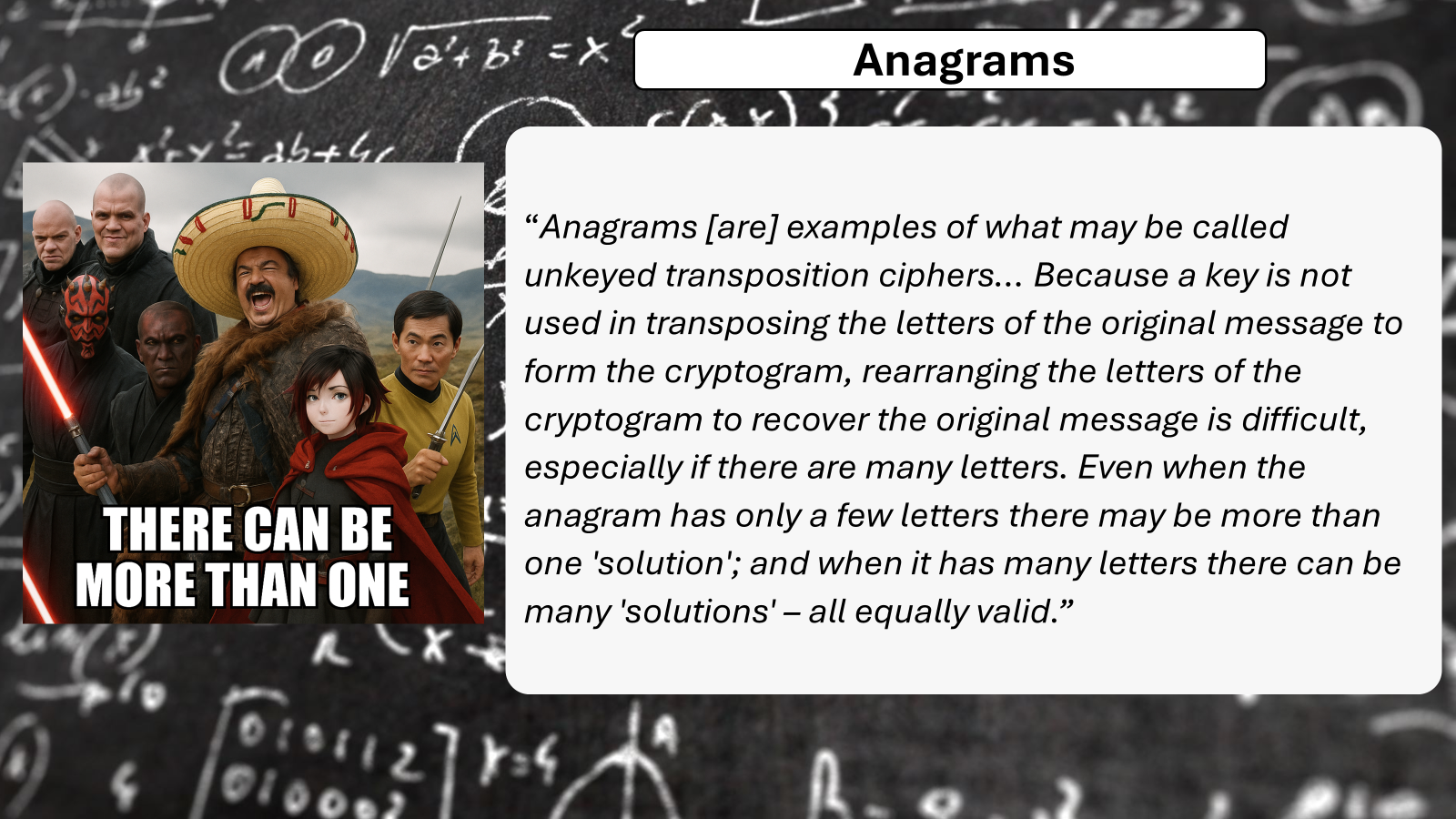
However, the Friedmans also noted that anagrams were widely used at the time, so that their possible use should not be unexpected, and noted the rules for a “perfect anagram”.
“In order to be 'perfect' an anagram should not only involve a rearrangement of letters without additions or deletions: the resulting word or words should in some way comment upon the original.”